TL;DR
The problem: Residents with months of unpaid dues still use the gym, and residents’ friends and guests take up equipment at peak hours with nobody answerable for them.
What helps: SmartAccessHub links gym access to dues and resident records. Your MC sets how long dues can stay pending before gym access pauses, and guests come in on time-bound passes.
The outcome: Residents who live here and pay their dues get a fair shot at the gym, and nobody has to argue at the door.
Why is gym access so hard to manage in a housing society?
The gym door has no way of knowing who has paid, who lives there, or who is just a friend tagging along. So it lets everyone in.
It’s 6:45 on a weekday morning. Anita from A-704 has about 40 minutes before she leaves for work. Both treadmills are taken by a neighbour’s college friends, who are staying for the week. The cross-trainer is in use by a resident who hasn’t paid maintenance in eight months. Anita does a few stretches, keeps checking the time, and goes back upstairs.
Ramesh, the guard at the clubhouse entrance, saw all of it. But he isn’t going to ask a resident to clear dues before using the gym, or ask a group of young men whose guests they are. Rajan from the MC knows about the dues too. He doesn’t want to have that conversation with a neighbour either.
- Chronic defaulters use the gym like everyone else. Dues are tracked in the accounts. Gym access is decided at the door. Nothing connects the two.
- Guests have no one answerable for them. Friends and relatives of residents walk in, often at peak hours. Nobody knows whose guests they are or how long they’ll stay.
- Residents who pay lose out. Early mornings and evenings are when most people can work out. That’s exactly when the equipment is taken.
- Guards are left to enforce it. They can’t remember every face, and they shouldn’t have to confront residents.
- There’s no reliable record. When someone complains, a paper register rarely settles who was in the gym and when.
Who counts as a chronic defaulter, and who decides?
A chronic defaulter is a resident whose maintenance dues have been pending for months. It isn’t someone whose payment is a week late or held up in a bank transfer.
This distinction matters. A rule that blocks someone over a few days’ delay will feel petty and cause more arguments than it settles. The rule is meant for the resident who has ignored reminder after reminder while still using the gym every day.
Where that line sits is your MC’s decision. In SmartAccessHub, the MC sets the limit itself, for example dues pending for more than three months. Anyone under that limit isn’t affected. Only residents who cross it lose gym access.
How do you automate gym access for chronic defaulters?
Connect the gym door to your community’s dues records. Gym access then pauses on its own once a resident’s dues pass the limit your MC set, and comes back as soon as the payment is recorded.
This is how it works in practice:
- The MC agrees with the policy. The rule covers the gym only. The main gate, the resident’s tower and the lifts are not touched, so nobody is ever locked out of their own home.
- The MC sets the limit. For example, gym access pauses when dues have been pending for more than three months.
- The system applies it. When a resident crosses that limit, their gym access pauses. Nobody has to update a list or brief the guard.
- Access comes back on its own. Once the payment is recorded, the resident can use the gym again. Nobody needs to re-add them.
It also changes how it feels for everyone. The same rule applies to every flat, so it doesn’t come across as one neighbour singling out another. And the resident finds out at the gym door, not from a guard in front of other people.
Share the policy with residents before it goes live. A rule people knew about in advance is far easier to accept than one that surprises them at the door.
How do you stop residents’ guests from crowding the gym at peak hours?
Give guests a time-bound pass that the resident issues. Every guest is then linked to a host, and every visit has an end time.
Guests themselves aren’t the problem. A resident’s brother visiting for the weekend should be able to use the gym. The trouble starts when nobody is answerable for them:
- A resident’s friends start using the gym every day, long after the first visit.
- Groups of guests turn up during the morning or evening rush, when residents most need the equipment.
- Nobody knows whose guests they are, so there’s nobody to speak to when it becomes a problem.
With a guest pass, the resident invites the guest through the app. The pass works only for the time and areas allowed, such as the gym on a given day. Once it expires, it stops working. If the gym does get crowded, the access log shows which resident each guest came with, so the MC can talk to the host instead of confronting the guest.
How does SmartAccessHub manage gym access?
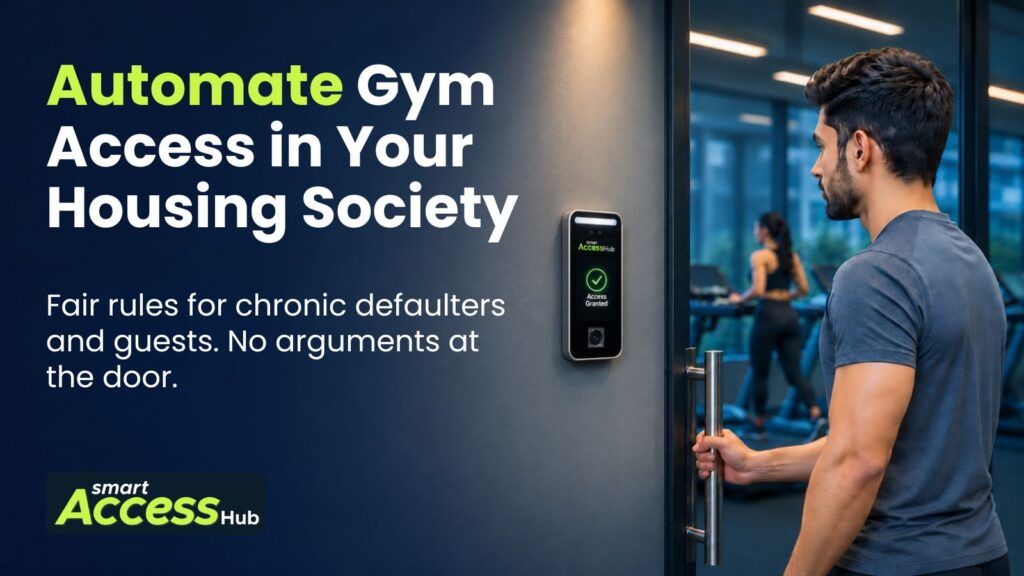
SmartAccessHub puts the gym door on the same platform as the main gate, tower lobbies, lifts and parking. It then applies your MC’s rules across all of them. It connects to your community’s existing system of record, so dues and resident status reach the gym door without anyone entering them twice.
Four parts do most of the work for the gym:
- Smart Rules. The MC sets the policy once, including how long dues can stay pending before gym access pauses. The platform applies it from then on.
- Face Key. Residents walk up and the door opens in about 0.6 seconds. There’s no card to forget or lend to a friend. Each face is stored as an encrypted string, not an image, which supports compliance with India’s DPDP Act, 2023.
- Smart Pass. Residents issue time-bound passes to guests, limited to the areas the MC allows.
- Access logs. Every entry is recorded, so questions about who used the gym and when have a clear answer.
Setting it up, step by step
- Agree the policy in the MC. Decide who can use the gym, how many months of pending dues count as chronic default, and how guests are handled. Write it down and share it with residents.
- Bring the gym door onto the platform. It then runs off the same records as the gate and lifts.
- Connect dues and resident records. Payment status reaches the gym door automatically.
- Enrol residents. Residents register through the app and start using Face Key.
- Set the rules. Apply the defaulter limit and guest pass policy through Smart Rules.
- Review the logs. Check them regularly to settle disputes and see whether any rule needs adjusting.
What are the benefits of automating gym access?
The gym goes back to the people it was built for, and nobody has to play bad cop to get there.
For the MC
- One policy, applied the same way to every flat, without confrontation
- A clear record of who used the gym and when
- A practical reason for chronic defaulters to clear their dues, since access returns once they do
For residents
- Equipment that’s actually free when they have time to work out
- No cards to carry and no waiting while a guard checks a register
- Guests are still welcome, on a pass that has an end time
For guards
- No more stopping a neighbour or asking whose guests are on the treadmill
What does the gym look like once the rules are in place?
A few weeks after the MC switched the rules on, Anita walks into the gym at 6:45 and the door opens as she reaches it. A treadmill is free.
The neighbour’s college friends came over at 11 that morning, on passes their host had sent them. The resident with eight months of dues pending found the gym door no longer opened for him. There was no guard and no scene. He cleared his dues that week, and his access came back once the payment was recorded.
Ramesh didn’t have to say a word to anyone, and neither did Rajan.
Frequently asked questions
Will a chronic defaulter be locked out of their own home? No. The rule covers the gym only. Entry through the main gate, into the resident’s tower and to their flat is not affected.
Who decides how long dues can stay pending before gym access pauses? The MC. The limit is set in SmartAccessHub, so a resident a few days late on payment isn’t treated the same as one who hasn’t paid in months.
What happens when a defaulter pays? Gym access comes back on its own once the payment is recorded in the community’s records. Nobody has to re-add them.
Can residents still bring guests to the gym? Yes. Residents issue guests a time-bound pass that covers only the areas the MC allows. When the pass expires, access ends.
How does the MC know whose guests are using the gym? Every guest pass is issued by a resident, and every entry is logged. If guests are crowding the gym, the log shows who their host is.
Do we need to replace our existing gym door hardware? It depends on your setup. A site assessment will show what can be connected and what needs to change.
Make the gym work for the people who pay for it
A gym run on a register and goodwill ends up serving whoever shows up first. When access is tied to clear rules, residents who pay their dues, get their time on the equipment, guests come in with a host and an end time, and nobody has to argue at the door. Your MC decides the rules once, and the system applies them every day.
If you manage a housing society and want to see how this would work for your gym, explore SmartAccessHub at smartaccesshub.com or request a demo.