TL;DR
The problem: Getting every flat to pay maintenance on time is a constant struggle. Reminders get ignored. Blocking amenities could help, but enforcing such rules on a consistent and fair basis is hard.
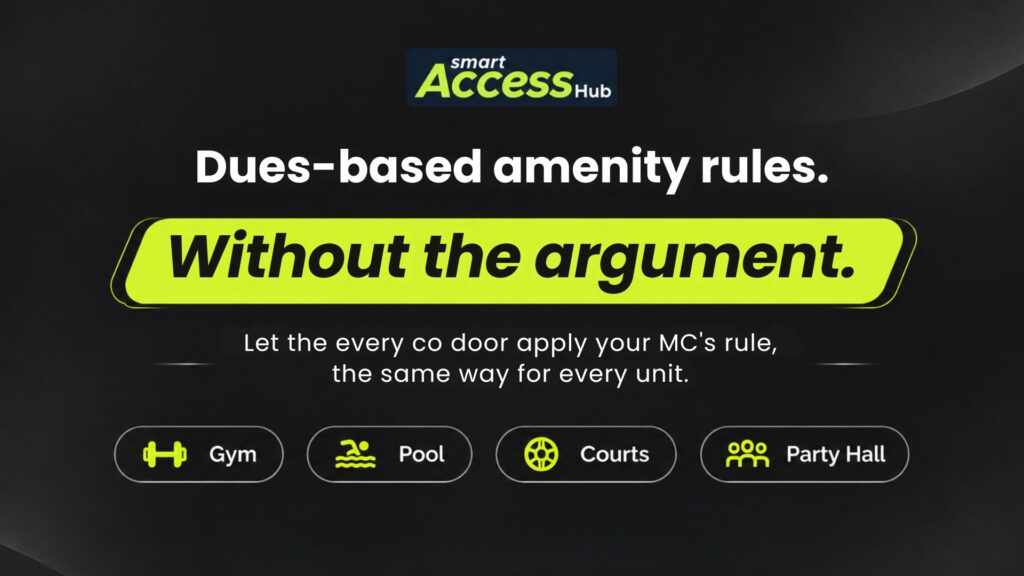
What helps: Instead of security guards trying to enforce such rules, setting up rules via an access control system works much better. Your MC sets a clear threshold for defaulters, the amenity doors check dues status automatically, and access comes back the moment the payment is recorded.
The outcome: The rule is applied the same way to every flat, residents who pay get the amenities they pay for, and nobody has to argue with anybody.
What is a dues-based amenity restriction?
A dues-based amenity restriction is a society rule that pauses a resident’s access to shared facilities, such as the gym, pool, courts or party hall, once their maintenance dues stay unpaid beyond a limit the Management Committee has set.
Three things define a fair one:
- It covers amenities only. Entry to the gate, the tower, the lift and the resident’s own home is never touched.
- It has a clear threshold. It applies to dues pending for months, not to a payment that is a few days late.
- It reverses on its own. Access returns as soon as the dues are cleared, without anyone having to approve it.
The rule itself is simple. The hard part has always been enforcing it without turning neighbours into opponents.
Why does enforcing it manually, usually end in confrontation?
Because the dues live in the accounts, but the decision has to be made at the clubhouse door. Checking a resident’s dues status at that moment, and deciding whether to let them in, is hard.
Manual enforcement breaks down for three reasons:
- Checking dues at the door is hard. The clubhouse has no live view of the accounts. Whoever is at the door decides from a list or from memory, and dues change every month, so that list is out of date the day after it is made.
- Manual enforcement always ends in an argument. The guard is made the enforcer without the authority or the latest information, and he still has to work in the same society tomorrow. The MC is made the villain, because every block feels like a personal decision about one flat. Done by hand, the rule is next to impossible to apply.
- An access control system on its own doesn’t solve it. If it isn’t connected to the community’s accounting (ERP) system, it can’t know dues status live. A resident who has paid can still be stopped at the door, and the confrontation happens anyway, this time with someone who has every right to be upset.
The damage goes beyond the door. Residents who pay on time start asking why they bother when the rule exists only on paper. And with no record of who used the clubhouse and when, every dispute at the AGM comes down to memory.
Is it fair to restrict amenities over unpaid dues?
In an apartment community, there are certain rights which cannot be restricted – for example, right to electricity, water, access to home, etc.
However, for shared amenities like clubhouse, which do not fall under the category of essential services, such restrictions can be allowed, as long as they are agreed upon by all owners through an AGM, and recorded in the byelaws of the community.
Maintenance pays for the pool chemicals, the gym equipment and the clubhouse staff. A resident who uses them for months without paying is, in effect, being subsidised by neighbours who do. Most residents see a restriction on amenities as reasonable. What they object to is a rule that feels selective, sudden or humiliating.
Before you switch anything on, settle these ground rules:
- Check your bye-laws. ⚠️ What a society can restrict, and how it must be approved, depends on its registered bye-laws and the rules in your state. Take advice if you are unsure.
- Never touch essential access. The main gate, tower lobby, lift, the resident’s flat, and water and power are off limits. A dues rule should never stop anyone from getting home.
- Make it the same for everyone. One threshold for every flat, owner or tenant. No case-by-case decisions at the door.
- Keep it private. No names on notice boards or in group chats. The rule does the work, not public pressure.
- Handle genuine exceptions in the office. A disputed bill or a family going through a hard time is for the MC to discuss in private, never for a guard to judge at the gate.
Which amenities should the rule cover, and how?
Apply it to facilities residents choose to use, and match the method to how each facility is used: walk-in doors need automatic checks, bookable spaces need booking-linked access.
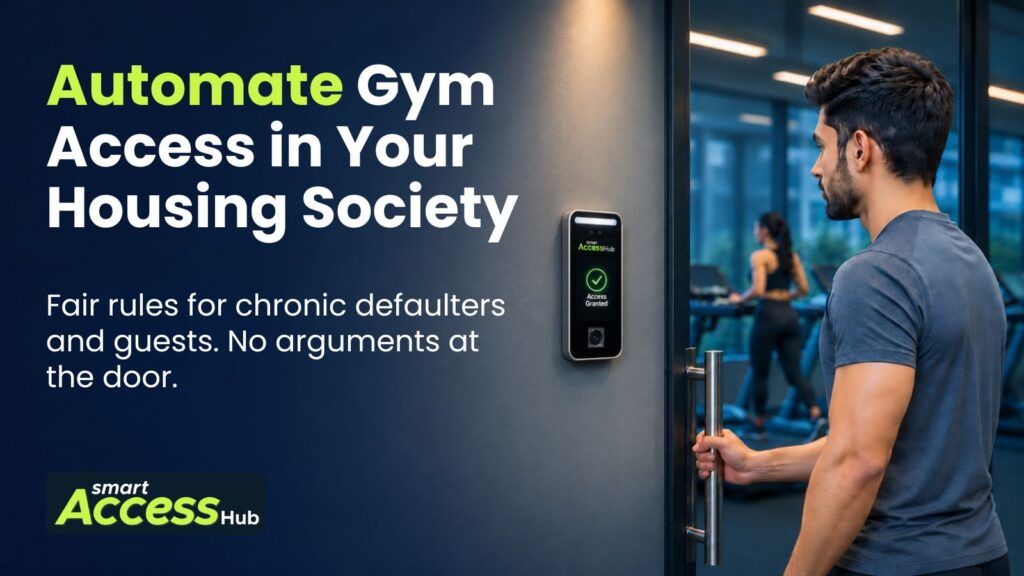
- Gym: Restrict. Apply the defaulter rule at the gym door, with face or app QR entry. See our guide to automating gym access.
- Swimming pool: Restrict. Apply the defaulter rule at the pool door, and add time windows for maintenance days.
- Badminton, tennis or squash courts: Restrict. Use booking-based access, so there’s no entry without a booking, and defaulters stay restricted at the door.
- Party hall or banquet hall: Restrict. Use booking-based access for the host, with event passes for guests that work only for the hall.
- Clubhouse lounge and indoor games: Restrict. Apply the defaulter rule at the clubhouse entry door.
- Main gate, tower lobby and lift: Never restrict. Residents keep normal access, untouched by the dues rule.
- Basement and parking: Not recommended. Keep normal resident access and treat parking as part of getting home.
Which credentials suit amenity doors?
- Face recognition for most residents. Nothing to forget or lend, so a defaulter can’t borrow a neighbour’s card to get in.
- App QR (SmartPass) for residents who prefer not to use face recognition.
- Time-bound guest and event passes for visitors, valid only for the facility and time the host allows.
- Staff QR ID cards for clubhouse staff, limited to the areas and hours they work.
Whichever credential a resident uses, the dues rule applies to the person, not to the card. That’s what closes the loophole.
How do you roll it out without confrontation?
Agree the rule in the open, announce it well before it starts, and then let the door do the enforcing. Most of the goodwill is won or lost before the first door ever says no.
- Write the policy down. Which amenities, what threshold, how exceptions are handled. Get it approved the way your bye-laws require, typically at a general body meeting.
- Set a threshold that targets chronic default. For example, dues pending for more than three months. A resident whose payment is a week late should never feel the rule.
- Keep essential access out of scope. State in writing that the gate, lobby, lift, parking and the flat are never affected. This one line removes most objections.
- Announce it with a start date. Share the policy with every resident, ideally a month in advance. Give anyone above the threshold time to clear dues or speak to the MC privately.
- Keep sending your usual reminders. The restriction should never be how a resident first learns they owe money.
- Brief the clubhouse staff. Their only job is to say, politely, that the office can help. No arguments, no checking lists, no discretion at the door.
- Switch the rule on and let it run. The same threshold applies to every flat, every day. Access returns on its own once payment is recorded.
- Review it after a few months. Check the access logs and collections, and adjust the threshold or the amenity list if needed. Report back to residents at the AGM.
A rule residents voted on, saw coming and can reverse themselves by paying feels like policy. The same rule sprung on them at the pool gate feels like a personal attack.
How does SmartAccessHub enforce dues-based restrictions?
SmartAccessHub connects every amenity door to your community’s dues records and applies the MC’s threshold at each one automatically. Nobody keeps a list, and nobody has to say no.
Here’s what happens behind the door:
- The MC sets the rule once in Smart Rules: the dues threshold and the doors it applies to, such as the gym, pool, courts or party hall.
- Your community’s records flag the dues. When a resident’s dues cross the threshold, the platform picks it up in real time.
- Every configured door applies it. Access pauses at those doors only. The gate, lobby, lift and parking carry on as normal.
- Payment brings access back. Once the dues are cleared and recorded, access returns automatically. Nobody re-adds anyone.
A few other parts make it work smoothly at the clubhouse and amenities:
- Face Key. Residents walk up and the door opens in about 0.6 seconds. Faces are stored as a double-encrypted string, not an image, and the ABRA framework keeps it consent-based and compliant with India’s DPDP Act, 2023.
- Booking-based access. For courts and the party hall, the door opens only during the slot the resident booked.
- Time-bound guest passes. Guests and event invitees get passes valid only for the facility and time their host allows.
- Access logs. Every entry and denial is recorded, so any dispute has a clear answer.
What are the benefits of automating the rule?
The rule finally works, and it stops costing the community its goodwill.
For the MC
- One policy, applied identically to every flat, with no case-by-case decisions
- No awkward conversations with neighbours
- A natural reason to clear dues, since access returns as soon as they do
- Less need for a guard at amenity doors, saving ₹2.4–3 lakh a year for each guard post replaced
For residents who pay
- Amenities used by the people who fund them
- Faster entry, with no cards to carry
For residents with pending dues
- No public embarrassment at the door
- Home access is never affected, and amenity access comes back the moment they pay
For guards and clubhouse staff
- No more refusing residents or keeping lists
- Time for the work that actually needs them
What does it look like once the rule is in place?
The change shows up in the treasurer’s inbox before it shows up at the door. Residents with long-pending dues see the policy weeks before it starts, and many clear their dues or set up a payment plan with the office rather than lose the pool or a party hall booking.
The printed defaulter list disappears from the guard’s cabin. When access is paused at an amenity door, the guard simply points the resident to the office, and that’s the end of his part. When a resident pays, their access is back before they reach the clubhouse.
Nobody stands in a doorway and refuses a neighbour. The rule does it, the same way, for everyone.
Frequently asked questions
Can a society restrict amenities for maintenance defaulters? In most cases, yes, for optional facilities and when the rule is part of the society’s approved bye-laws or policy. ⚠️ Check your own bye-laws and state rules before you start.
Will a defaulter be locked out of their home? No. The rule applies only to the amenity doors the MC chooses. The gate, lobby, lift, parking and the flat are not affected.
Who decides the threshold? The Management Committee. It sets the limit in Smart Rules, so a resident who is a few days late isn’t treated like one who hasn’t paid in months.
What happens when the resident pays? Access comes back automatically once the payment is recorded in the community’s records. Nobody has to update a list.
What if a resident disputes the dues? That conversation belongs in the MC office. Decide in your policy how disputed amounts are handled, so the door is never where a dispute is settled.
Can a defaulter use a family member’s card? Not with face recognition, because the face is the credential. Each person’s access is tied to their own profile.
Do we need new hardware? It depends on what you have. A site assessment shows which existing doors can be connected and what needs to change.
Let the rule do the enforcing
A dues rule that depends on a guard and a printed list will always end in either an argument or an exception. Tie amenity access to your records, agree the threshold in the open, and the rule applies itself, fairly, every day. Your MC decides once. Nobody has to say no at the door again.
If you manage a housing society and want to see how this would work across your clubhouse, pool and party hall, explore SmartAccessHub at smartaccesshub.com or request a demo.
Feels Like Magic. Built Like a Fortress.