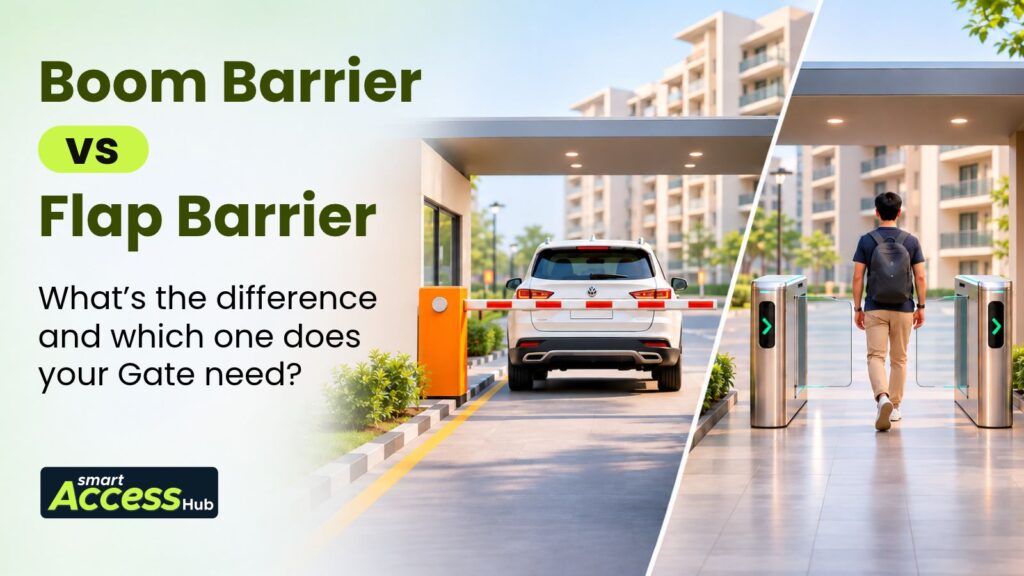
A boom barrier lets in verified and authorised vehicles, whereas a flap barrier lets in verified and authorised people. That one difference decides which of the two belongs at which entrance of your society.
The two are often mistaken for alternatives, but they solve different problems. This blog explains what each one does, how they compare in practice, and how to match them to your gates.
What is a boom barrier?
A boom barrier is a horizontal arm that swings upward to let a vehicle through and lowers behind it to close the lane. It is the familiar bar at a shopping mall parking entry, a highway toll booth.
Modern ones are motor-driven. Loop detectors and infrared sensors stop the arm from closing on a vehicle or a person. Because the arm only spans a lane, it suits car lanes and basement ramps.
Boom barriers come in manual and automatic versions. A manual one depends on a guard to lift the arm. An automatic one opens on a signal from a reader or sensor and closes by itself once the vehicle has cleared.
What is a flap barrier?
A flap barrier, also called a speed gate, is a narrow pedestrian lane with a pair of retractable panels, called flaps, set into housings on either side. When an authorised person approaches, the flaps open. Once the person has passed, they close.
Here too, infrared sensors watch the lane. If a second person slips through right behind the first, a practice known as tailgating, the system raises an alarm. A swing version uses wider, door-like panels and is also suited to wheelchair users.
Because the flaps retract instead of rotating, people walk through without pushing against anything, which keeps the lane moving even at rush hour. The same lane can also be set to work in both directions, so one lane can serve arrivals in the morning and departures in the evening.
How do they compare?
Beyond what they stop, the two differ in three practical ways.
On flow, a boom barrier handles one vehicle at a time and suits a steady stream of cars. A flap barrier admits one person at a time, which keeps entry orderly.
On footprint, a boom barrier needs a full vehicle lane plus room for a long arm to swing. A flap barrier needs only a narrow lane about as wide as one person, or a little more for the swing type.
Their weak spots mirror each other. A boom barrier controls vehicles, not pedestrians, and a flap barrier is not designed for vehicles at all.
Which one does your gate need?
Match the barrier to who crosses the lane:
- A lane for cars and two-wheelers: a boom barrier.
- A lane for people on foot: a flap barrier, or its swing version where wheelchairs, prams or bulky deliveries pass often.
- Basement and parking ramps: a boom barrier, since only vehicles use them.
A main gate that carries both cars and walkers needs both: a boom barrier on the vehicle lane and a flap barrier on the pedestrian lane. Installing only a boom barrier leaves everyone on foot to the guard’s judgement.
How does each barrier know who to let in?
Neither barrier decides anything on its own. It obeys whatever reads the credential. On a vehicle lane that is usually an RFID tag or a number-plate camera. On a pedestrian lane it is typically a face-recognition device, an app QR code or an access card.
The choice of credential shapes how smooth the vehicle lane feels. With an RFID tag, the reader authenticates the car without the driver stopping or rolling down a window, and the arm lifts as the car arrives. A number-plate camera suits cars that carry no tag.
SmartAccessHub connects both lanes to one central system, so the main gate treats a resident the same way on foot and in a car. When a tenant moves out and is deactivated, access ends at every door at once, including the boom barrier and the flap lane. Visitors get a pass valid only for specific doors and a set duration.
The bottom line
Choose by who crosses the lane, not by which barrier looks more advanced. Vehicles get a boom barrier, people get a flap barrier, and most main gates need one of each.
To see both lanes running from a single system in a live community, request a demo.